

The application of high-temperature resistant, non-partitioned HEPA filters in dry heat sterilization cabinets (commonly used for material sterilization) and tunnel ovens (used for continuous sterilization) is one of the core elements of sterile production in the pharmaceutical industry. It is also one of the most classic and stringent application scenarios for this technology. Below is a detailed technical application description:
I. Application Segments and Core Functions
1. Application Equipment:
- 1.1 Tunnel Oven: A continuous sterilization device that connects the bottle washer and the filling machine. After being cleaned, vials such as ampoules and vials are conveyed by a conveyor belt, passing through the preheating zone, high-temperature sterilization zone, and cooling zone of the tunnel oven in sequence.
- 1.2 Dry Heat Sterilization Cabinet: A batch sterilization device mainly used for dry heat sterilization and pyrogen removal of stainless steel utensils, glassware, and materials.
2. Application Locations:
- 2.1 High-temperature Sterilization Zone: In this area, the HEPA filter ensures that the hot air entering is sterile, thereby achieving direct and uniform heating of the bottles.
- 2.2 Cooling Zone Exit (the most critical location): This is the core application point of the filter. Bottles that have undergone high-temperature sterilization at over 300°C enter the cooling zone and are cooled to near room temperature. At this point, the cooling air must pass through a high-temperature resistant HEPA filter to absolutely ensure that the bottles, after leaving the oven and entering the A-grade laminar flow filling area, are not contaminated by particles and microorganisms in the ambient air.
3. Core Functions:
- 3.1 Providing Sterile Hot Air for Sterilization: In the high-temperature zone, it ensures that the hot air itself is sterile and does not introduce contamination.
- 3.2 Providing Sterile Cold Air for Cooling (core function): In the cooling zone, it creates a sterile cooling environment for bottles that have undergone high-temperature sterilization. This is the last physical barrier to ensure the “sterile” attribute of the product.
- 3.3 Pyrogen Removal**: An important function of dry heat sterilization is the destruction of bacterial endotoxins (pyrogens). The HEPA filter itself does not remove pyrogens, but by providing clean hot air, it ensures that no new bacteria and endotoxin contamination sources are introduced during the high-temperature pyrogen removal process.
II. Why Must “High-temperature Resistant” and “High-efficiency” Filters Be Used in This Segment?
1. Extreme High-temperature Resistance (usually required above 300°C – 350°C):
- 1.1 Process Requirements: The process temperature for dry heat sterilization and pyrogen removal is usually above 250°C and maintained for over 30 minutes. The temperature in the high-temperature zone of the equipment can reach 300°C – 350°C. Filters installed in the high-temperature zone must be able to withstand this temperature in the long term.
- 1.2 Material Stability: The filter must use stainless steel frames, special high-temperature sealing compounds, and glass fiber filter paper to ensure that it does not decompose, carbonize, or release any volatile substances under long-term high-temperature conditions, otherwise it will contaminate the product.
2. High-efficiency Filtration (must reach H14 level or higher):
- 2.1 Target of Capture: The goal is to capture all bacteria and particles. Bacteria are usually larger than 0.5μm, but the carrier particles they adhere to may be smaller. The H14 efficiency level (filtration efficiency for 0.3μm particles ≥99.995%) is sufficient to effectively intercept microorganisms and particles.
- 2.2 Regulatory Compliance: GMP (Good Manufacturing Practice) and FDA regulations clearly require that air used in critical process areas for sterile products must be filtered through high-efficiency filters and achieve A-grade cleanliness standards.
3. Advantages of Non-partitioned Design:
- 3.1 No Shedding Risk: It avoids the risk of metal shavings that may be produced by the metal partitions of partitioned filters due to thermal expansion and contraction or vibration. Metal shavings are a serious source of contamination.
- 3.2 High Dust Holding Capacity: Suitable for tunnel ovens that run continuously for 24 hours, extending service life.
- 3.3 Lightweight**: Reduces the load on the internal structure of the oven.
III. Specific Technical Requirements and Industry Characteristics
1. The Highest Sterility Assurance Requirements: This is the last process in direct contact with the inner packaging containers of pharmaceuticals (vials). Its sterility assurance level (SAL) must reach ≤10⁻⁶, that is, a contamination probability of one in a million. The integrity and high efficiency of the HEPA filter are the cornerstones to achieve this goal.
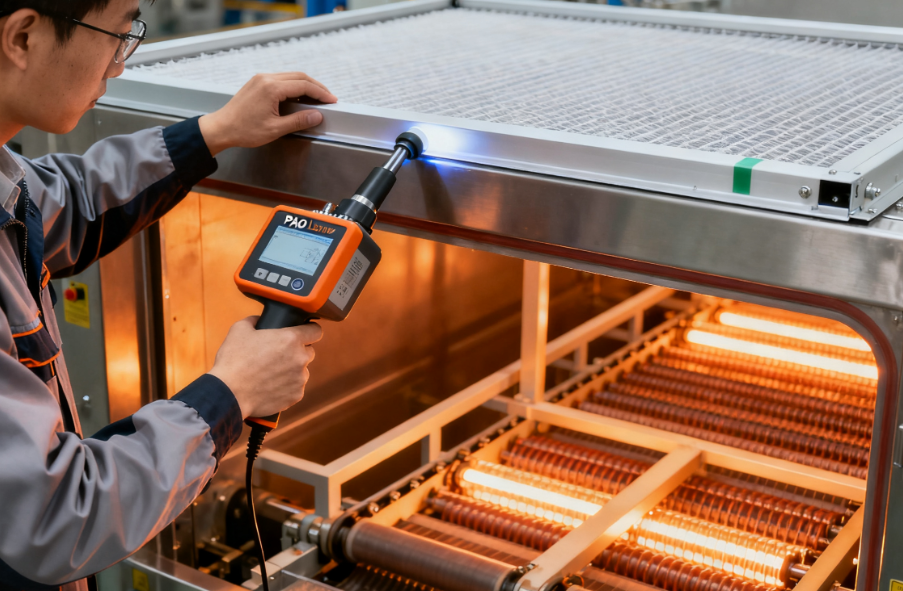
2. Strict Verification and Leak Testing: After installation, strict on-site PAO/DOP smoke scan leak testing must be carried out: this is a mandatory requirement of GMP. It must be ensured that the filter itself is defect-free and the seal between the filter and the installation frame reaches “zero leakage”. Any tiny leakage means the failure of sterility assurance.
3. Regular Integrity Testing: The filter needs to be tested for leaks regularly (usually every 6-12 months) to ensure that it remains effective throughout its service life.
4. Material and Documentation Requirements:
- 4.1 Material Certification: All materials need to have certification that meets pharmaceutical-grade requirements, such as FDA certification, to ensure their safety.
- 4.2 Complete Traceability: From production to installation, a complete documentation package must be provided, including factory inspection reports, material certifications, certificates of conformity, etc., to meet GMP audit requirements.
IV. Summary of Application Value and Importance
1. The Lifeline of Sterile Products: It directly determines whether injectables and other sterile drugs can avoid microbial contamination. It is one of the most critical safeguards for patient medication safety.
2. A Hard Requirement for GMP Compliance: It is a basic requirement for sterile production lines by pharmaceutical regulatory agencies in various countries, with no alternative solutions.
3. Avoiding Huge Economic Losses: If a batch of products is scrapped or recalled due to air contamination, the loss is enormous. The HEPA filter is the most cost-effective risk control measure.
4. Protecting Corporate Reputation: Any sterile issue can cause a devastating blow to a pharmaceutical company’s reputation.
Conclusion: In dry heat sterilization cabinets and tunnel ovens, high-temperature resistant, non-partitioned HEPA filters are by no means ordinary accessories. They are “core safety components” in sterile production processes. Like an impregnable barrier, they guard the most critical passage from high-temperature sterilization to sterile filling. The reliability of their performance is one of the most closely watched focuses in a pharmaceutical company’s quality system. Their selection, installation, verification, and maintenance must all follow the strictest standards and procedures.
Post time: Nov-06-2025